


Intercom Systems – Full-Duplex Wireless Communication
Full-duplex radio communication in construction.
People with disabilities, just like able-bodied individuals, want to participate in guided tours or independently and autonomously participate in cultural events and exhibitions. In public facilities, especially cultural ones, amenities for people with various disabilities are not yet commonplace and are not found in every venue. These individuals encounter many obstacles, and sometimes even exclusions, preventing active participation in many events, or simply – ordinary viewing of exhibitions.
Accessibility for all: audioguide and tourguide as support for people with disabilities
Being independent and using solutions that enable, for example, independent navigation through an exhibition, are particularly important for people with disabilities. In cultural institutions or other public facilities, it is especially important that everyone, regardless of their level of ability, can move around the facility and that it is accessible to everyone.
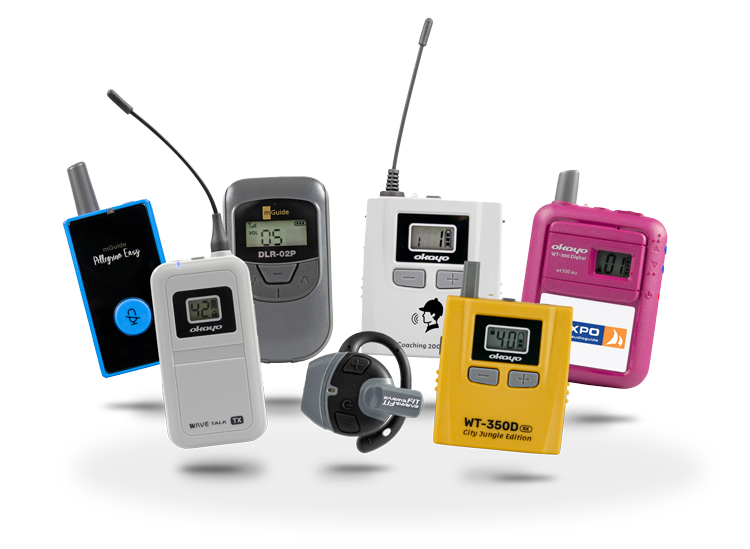
One of the modern solutions are audioguide systems and tourguide systems, which are a great convenience for people from various groups:
- with visual impairments,
- children and seniors, with disabilities,
- hearing aid users.
Thanks to audioguide systems, all these individuals can independently, without the need for assistance, visit, for example, an exhibition in a museum, and thanks to tourguide systems, participate in a guided tour.
For user comfort: solutions for people with disabilities
The above devices are designed with the needs of people with various disabilities in mind. They are equipped with clear, high-contrast displays, as well as tactile bumps on the keyboard or casing, which facilitate system operation for blind and visually impaired individuals. Sound regulation and its wide range are particularly helpful for hearing-impaired individuals, who can set the receiver volume according to their individual preferences and do not have to worry about not hearing the guide or the broadcast. The devices are designed to fit securely in the hand and can be operated by people with, for example, motor disabilities.
Audioguide broadcasts can start automatically, allowing people with various disabilities to visit an exhibition and listen to prepared recordings without the help of third parties. They can guide the visitor through the facility, enabling them to smoothly navigate and explore all exhibits located in the institution.
One of the other solutions that can significantly improve the quality of a visit within the facility itself is an induction loop. This is a hearing assistance system for people with hearing impairments who use hearing aids or implants. Thanks to the induction loop, sound free of noise and interference reaches the ear of the hearing-impaired person directly. An induction loop can be installed in a space, for example, laid under a carpet in a conference room, or it can come in the form of a lanyard worn around the neck, connected directly to a tourguide or audioguide device.
Many tourguide systems feature HAC – Hearing Aid Compatibility, allowing individuals with hearing impairments to receive sounds without the additional element of the aforementioned neck-worn induction loop.
Often, blind individuals do not participate in sports events, cultural events, film screenings, or other performances. Audio description for people with visual impairments comes to the rescue. This is a form of conveying art and describing what is happening on stage, the field, or the screen. Thanks to mobile systems such as tourguide and audioguide systems, blind individuals can fully participate in organized events.
As can be seen, there are a number of amenities and opportunities for people with disabilities to participate in cultural and sports events, attend film screenings, guided tours, or visit museum exhibitions. Tourguide and audioguide systems can prove to be an invaluable convenience and sometimes the only possibility for a person with mobility, visual, or hearing impairment to independently and autonomously participate in many activities that, until recently, were only available to able-bodied individuals.